
Before Sun 209: Bill Monroe’s “Blue Moon of Kentucky” on Columbia 37888
Seven years before Elvis Presley, Scotty Moore, and Bill Black turned it into the B-side of the most famous debut single in rock and roll history, “Blue Moon of Kentucky” was a Columbia hillbilly release with an unhurried trip through the trade press. The paper trail below — an advance listing, a label ad, and a review — tracks the record’s path through The Billboard in the fall of 1947, a year before “bluegrass” even existed as a name for the music it helped invent.
The Session
Bill Monroe and his Blue Grass Boys recorded “Blue Moon of Kentucky” on September 16, 1946, during an evening session at the WBBM-CBS studio in Chicago’s Wrigley Building, produced by Art Satherley.1 The date carries weight beyond this one song: it’s the first recording session by the lineup now remembered as the Original Bluegrass Band — Monroe on mandolin and tenor vocal, Lester Flatt on guitar and lead vocal, Earl Scruggs on banjo, Chubby Wise on fiddle, and Howard “Cedric Rainwater” Watts on bass — the quintet whose instrumental blend became the template for the genre.2 Monroe had written the song around 1945 as a 3/4 waltz and had already been performing it live, debuting it on the Grand Ole Opry on August 25, 1945.3
Columbia held the recording for almost exactly a year before pairing it with “Goodbye, Old Pal” as Columbia 37888.


Disc: Maroon label, gold print.
CCO 4607 A B I- / C 4358 A 7A
Advance Record Releases — September 20, 1947
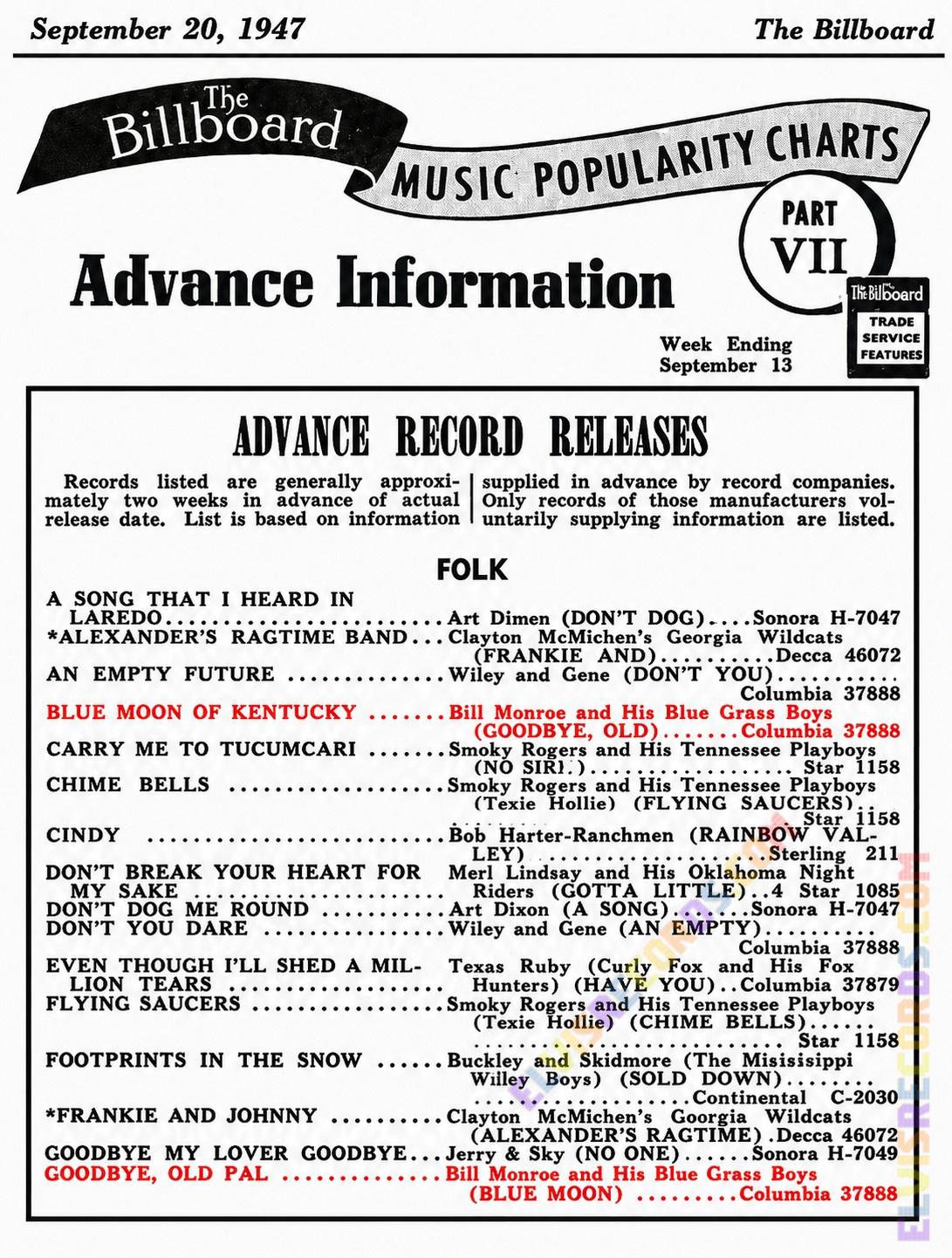 The first public sign of the release comes from The Billboard’s Music Popularity Charts, Part VII, “Advance Information” section, in the September 20, 1947 issue, covering the week ending September 13. Billboard’s own methodology note at the top of the page explains the timing: “Records listed are generally approximately two weeks in advance of actual release date. List is based on information supplied in advance by record companies.” The image to the left is a combination of the Billboard’s two pages.
Under the Folk heading, the two-sided release is listed both ways, each side cross-referencing the other:
BLUE MOON OF KENTUCKY …… Bill Monroe and His Blue Grass Boys (GOODBYE, OLD) …… Columbia 37888
GOODBYE, OLD PAL ………….. Bill Monroe and His Blue Grass Boys (BLUE MOON) …… Columbia 37888
Billboard’s own “two weeks in advance” note is useful for dating the release precisely: a September 13 advance week points to a release in the final third of September 1947, which lines up with the September 22, 1947 release date on record in bluegrass discographies — not the “early 1947” or “November 1947” dates sometimes cited elsewhere.4
The Trade Ad — September 27, 1947
The following week, Columbia ran a straightforward trade ad built around a photograph of Monroe mid-performance, mandolin in hand, hat on, caught singing.
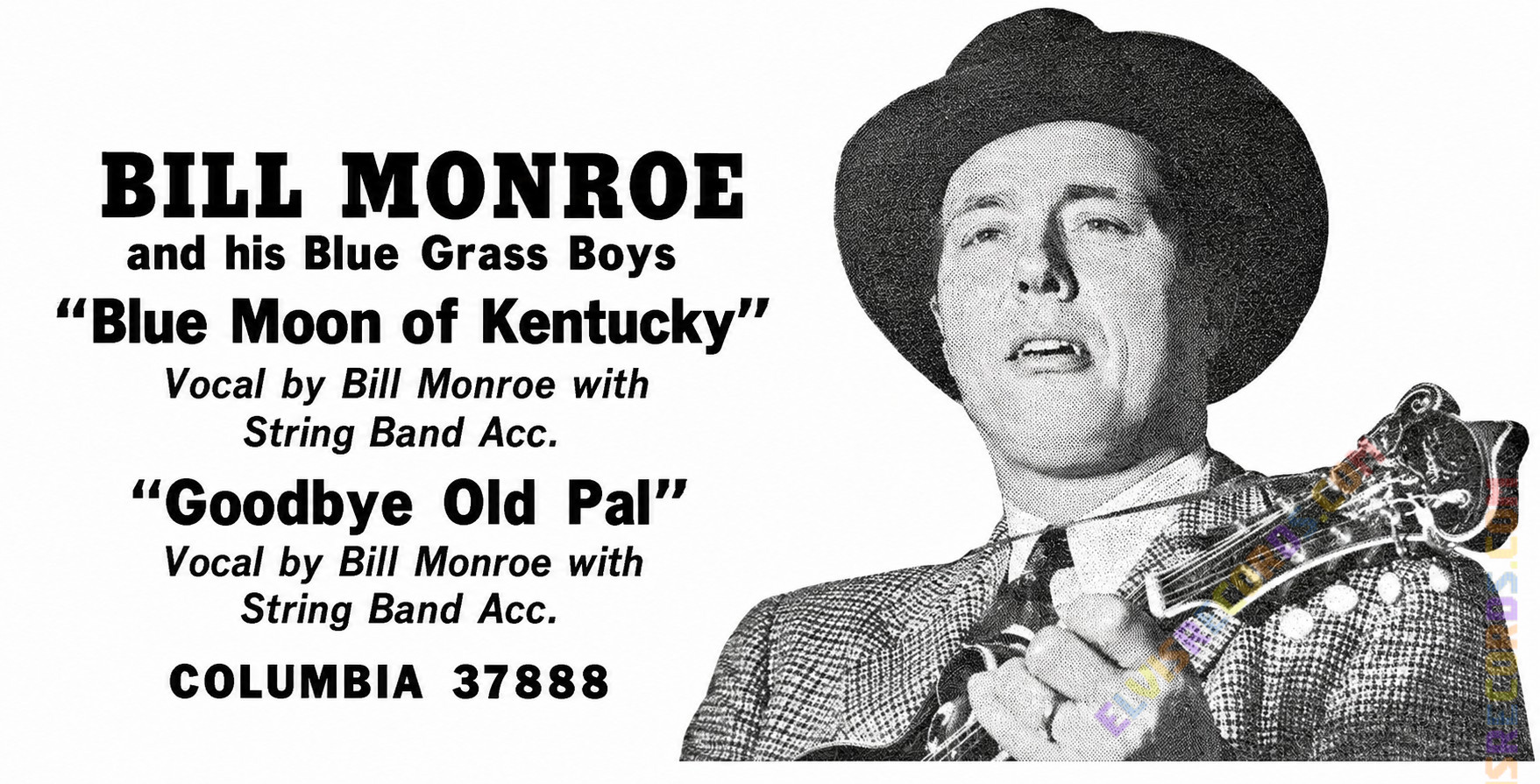
The copy is plain label boilerplate for the era:
BILL MONROE and his Blue Grass Boys
“Blue Moon of Kentucky” — Vocal by Bill Monroe with String Band Acc.
“Goodbye Old Pal” — Vocal by Bill Monroe with String Band Acc.
COLUMBIA 37888
Notably, the ad describes the backing as “String Band Acc.” — Columbia’s own marketing hadn’t caught up to the fact that this same group was, musically, inventing the sound that would eventually be named after the band itself. “Bluegrass” as a genre label was still years away.
The Review — November 15, 1947
The record finally reached Billboard’s review pages on page 112 of the November 15, 1947 issue, nearly two months after the advance listing. Reproduced here complete with the original’s spelling errors:
“The top tenoring of Bill Monroe, his pipes husky with the grass country flavoring, makes it a nostalgic nicety for his Blue Moon of Kentucky waltz. The mandolin, fiddle and guitar of his Blue Grass Boys capture the spirit of his singing in their playing. For the flip, Monroe takes it at a lively clip and adds a lick of yodeling to his old-time singing of his sentimental Old Pal ballad. For those favoring the old-time singing and playing.”
It’s a modest, workmanlike trade review — Billboard had no way of knowing it was describing a record that would later be added to the Library of Congress National Recording Registry, let alone one whose B-side would be reborn seven years later as the flip of rock and roll’s opening shot.
Why It Matters to Elvis Collectors
On July 7, 1954, at Sun Studio in Memphis, Elvis Presley, Scotty Moore, and Bill Black needed a B-side to back “That’s All Right,” cut two days earlier. By Scotty Moore’s own account, it was Bill Black who broke the deadlock, fooling around on bass and singing Monroe’s waltz in falsetto during a break; Elvis joined in, and the trio — egged on by Sam Phillips from the control room — turned Monroe’s stately 3/4 waltz into a driving 4/4 arrangement.5 Phillips is said to have responded, “Hell, that’s a pop song now.”[5] The finished take — matrix U-129, running about 2:03 — was released July 19, 1954, as the B-side of Sun 209, credited on the label simply to “Elvis Presley, Scotty and Bill.”
Monroe’s own reaction has become part of Nashville lore: rather than resent the reworking, he later re-recorded “Blue Moon of Kentucky” himself in Elvis’s faster 4/4 tempo, and the song remained a fixture of his live shows for the rest of his career — a rare case of a bluegrass standard and a rock and roll landmark sharing the same three minutes of melody.
- On This Day #66 – First Bill Monroe Recording with Flatt & Scruggs, Bluegrass Today, Sept. 16, 2021. ↩
- The Original Bluegrass Band, Wikipedia. ↩
- Blue Moon of Kentucky, Library of Congress National Recording Preservation Board. ↩
- I’m Going Back To Old Kentucky #357, Bluegrass Today, Sept. 22, 2011. ↩
- Sun Records Sessions — Elvis Presley (1954–1955), Library of Congress National Recording Preservation Board. ↩